
Valve body repair
Valve Bodies, Solenoids and Hydraulic System Testing
Technical guides on valve body repair, hydraulic control circuits, solenoids, separator plates, valves, bores, wear points, testing procedures, rebuilding methods, and related replacement parts. This section is designed for transmission rebuilders, valve body specialists, repair shops, suppliers, and parts professionals working with automatic transmission hydraulic control systems.

Transmission general data
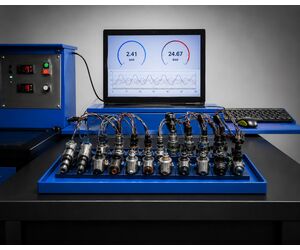
Many Valve Body problems are due to solenoid issues. Typically, a Solenoid tester is similar to a Valve Body testing unit - it is offered by the same manufacturing companies with similar software and hardware changed to do job only on Solenoids. It comes as an efficient solution to smaller-scale transmission repair businesses looking for a more affordable solution to improve their Valve Body rebuilding quality and general automatic transmission rebuild standards as well.
Solenoid testing machines are used for checking the state of solenoids produced by different manufacturers of automatic transmissions. Separate solenoid test blocks make it possible to run tests for the majority of most popular makes on the actual international market. Modern Solenoid Test machines now typically come as a universal model and allow to cover any transmission specialists’ preferences in transmission rebuilding operations.
Modern Solenoid Test tools allow possibility to run tests at maximally high required temperature and solenoids are tested as they function with the valve body, as originally designed. The automatic transmission solenoid is an electromechanical regulator in the gearbox, in response to the computer impulse it opens or closes the channel in the hydraulic unit to control flows of hydraulic fluid. Solenoids control the hydraulic switching of operation modes in modern automatic transmissions, CVT and DSG. The solenoid is inserted in the channel of the hydraulic unit and is fixed by bolts (or a pressure plate) and at the other end through the plug of the wiring harness it is connected to the electronic control unit of the automatic transmission.
How to repair this transmission (Videos)RayTech Tester for Transmission SolenoidHydra-Test Solenoid test machine guideTransmission Solenoid Testing (Ohms Law)Automatic Transmission Basic Solenoid TestingHow to test automatic transmission solenoid status: OK or Bad ?Hydra-Test HT-SOL 25 - IntroHow to test a Transmission Solenoid
Instruction manuals and useful linksLink typeSourceDescription0Gears MagazineTransmission Solenoid Test Methods0Gears MagazineUnderstanding GM 6T40 Solenoids0Gears MagazineSubaru Lineartronic CVT Lock-Up Solenoids0Gears MagazineFord Solenoid Strategy Numbers: Is It Necessary to Program?
Some shops opt to just replace all the solenoids on the valve body. On some models that makes sense as the replacement solenoids are fairly cost effective. For other models, the cost of either OEM or aftermarket replacement solenoids do make it worthwhile to test and only replace the ones that are worn or faulty.
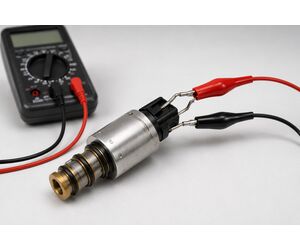
When
we talk about testing, we not only need to understand why we are testing it,
but more importantly, the
how do we test it. The “why” is fairly
straight forward, as we want to determine if it is still functioning properly
and that we can reuse it. The how to
test it might not be as clear, and there are multiple methods of how to test,
and sometimes opinions on how to test that are not always accurate.
In our last article we talked about transmission solenoid frequency and how it relates to the mechanical response of a solenoid when Pulse
Width Modulation (PWM) is used to control a solenoid. We discussed some of the
theory, but what does this look like with an actual solenoid? How does
frequency affect the response of a solenoid and how critical is matching the
OEM frequency when driving a solenoid, especially when we start talking about
testing and reclaiming solenoids.
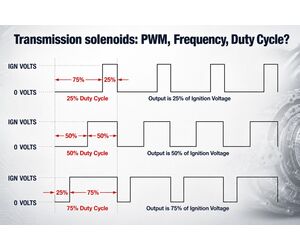
In the last couple of articles, we used terminology relating to pressure control solenoids such as PWM, Frequency, and Duty Cycle. In this article I thought I would go into depth on what these terms really mean and how they relate to
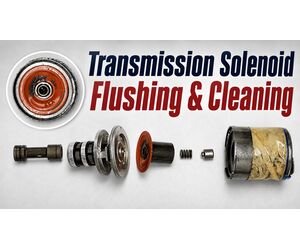
Over
the years I have heard several different philosophies when it comes to flushing
and cleaning transmission solenoids. Most hydraulic solenoid test machines have either flush
mode or an external cleaning system for solenoids. It is easy to think of it
like you are putting the solenoid in a dishwasher of sorts and
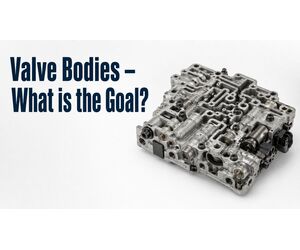
Over
the past few decades valve bodies have become the single most complicated part
of the transmission. The control has become very complex as we’ve gone from simple
4 speeds to electronically controlled 6, 7 and now even 10 speeds. They have
also
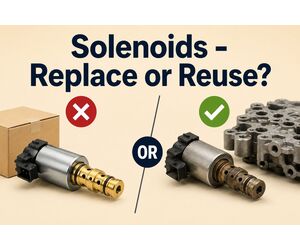
Solenoids
can become a hot topic of conversation at transmission shops. Some say the best way is to treat them like a
soft part and replace them on every rebuild, whereas other say that you can
check them and only replace the ones that are faulty or worn out. The first group
will say any reuse leaves you open to
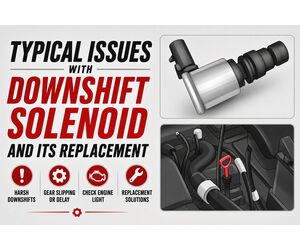
Automatic transmissions function with the
help of hydraulic pressure to implement the process of gear shifting itself,
and utilize valve body solenoids to handle the pressure of the ATF to specify
the shifting points. There are many solenoids responsible for different gear
shifting operations, and in this article we will have a closer look at
downshifting solenoids.
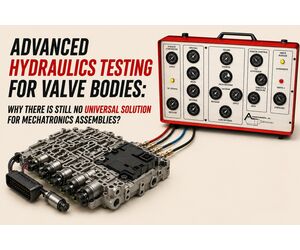
This part 2
is a conclusion to our 2-part insight into the Transmission Control Module /
Mechatronics Units testing.
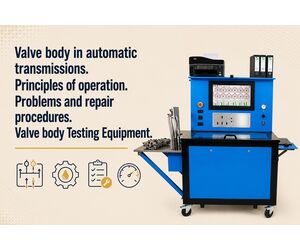
The valve body is a hydraulic “controller” (also
called as a “transmission brain”) consisting of valves, solenoids, sensors
batteries and attached to them are passages and channels, which guide the flow of
ATF to various valves with the purpose to
activate required clutch and shift the gear properly according to the driving
situation.