Transmission Solutions for Trucks and Commercial Vehicles
Transmission Solutions for Trucks and Commercial Vehicles
All motorized vehicles have a transmission, which transmits torque from the engine to the driving wheels. At the same time, the function of the standard transmission is to adjust the speed of the vehicle depending on road conditions, vehicle loading level, etc. Producers of automobile gearboxes offer new technical solutions, which use fuel more efficiently, are easier to operate, and ensure comfortable driving, as well as enhanced reliability and maintainability. Therefore, modern gearboxes for trucks and commercial vehicles are innovative high-tech products with integrated electronic control systems.
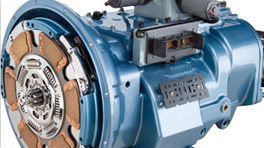
Eaton’s 18-speed AutoShift transmission
When moving, vehicles are affected by different
resistance forces, such as friction force from interaction with the road
surface. Therefore, vehicles have to accumulate power required to overcome resistance
forces for starting from a standstill and accelerating. The road resistance is called
tractive resistance, and the traction, which overcomes this resistance, creates
the tractive effect. In addition to road resistance, vehicles have to withstand
air resistance. For trucks it is especially important, as air resistance is
proportional to the area of the vehicle frontal projection and its speed raised
to the third power (s^3). Thus, truck manufacturers have to pay close attention
not only to the gearbox and the gear ratio parameter (min and max), but also
bring these parameters into correlation with power, vehicle’s own weight, gross
vehicle weight, etc. When selecting gearbox for a vehicle, specialists take
into account power-to-weight ratio, i.e. ratio of maximum engine power to its
gross weight.
Learn how MAN’s
trucks are assembled
The gearbox characteristics have a significant effect on fuel efficiency. Well-known companies such as Eaton, Allison, ZF are continuously developing new gearbox solutions, which provide significant advantages for owners of commercial trucks. It should be noted, that the transmission performance depends on road conditions, engine operating cycle (long periods of driving with constant speed or frequent stops and starts), vehicle average speed, etc.
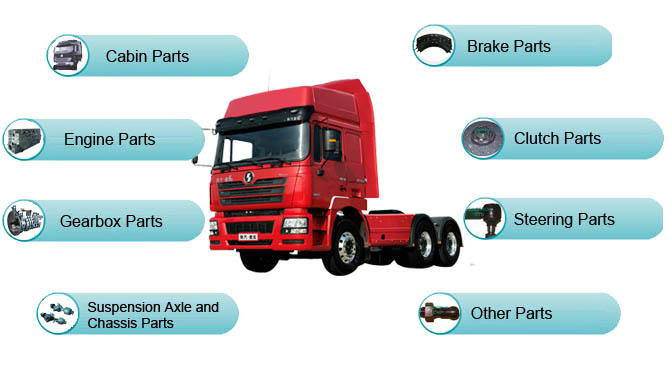
Trucks vary greatly in size, power, and configuration;
smaller varieties may be mechanically similar to some passenger automobiles.
These vehicles can be very large and powerful, and may be configured to adjust
specialized equipment, such as in the case of fire trucks and concrete mixers
and suction excavators. Modern trucks are largely powered by diesel engines,
although small to medium size trucks with gasoline engines exist in the US,
Canada, and Mexico. Modern trucks are designed to run long distances.
Therefore, these vehicles should be equipped with very reliable and durable
gearboxes.
The truck transmission is a combination of
interrelated units, which help to transmit the engine torque to the driving
wheels. Moreover, the torque value and its direction may be changed depending upon
other factors. Transmissions of different brands and models of trucks have
their peculiarities, which are determined by such factors as the number of
driving axles, individual design features of the vehicle, etc. Manual truck standard
transmissions necessarily include such components as clutch, gearbox, propshaft,
transfer case.
Truck components and
their assembly
As for the torque, which is transmitted with the help
of the transmission to the leading wheels of the truck, it is directly
proportional to transmission gear ratios. Gear ratios are determined by
engineers for each particular vehicle during the process of its development.
The torque value is determined by technical and dynamic characteristics, which
should be implemented in the model being developed.
Transmission trends in the segment of trucks and commercial vehicles
Crawling
through narrow urban areas in the traffic with frequent stop and go, moving
through the dugout tire tracks of a mudded building site, or rolling through
residential refuse duties – targeted application of Class 6 - 8 trucks or
commercial vehicles can set specific requirements for gearboxes compared to
their on-highway counterparts. Yet, it hasn’t stopped a general trend of
automation in trucks and commercial vehicles, which especially affected
gearboxes.
The manual gearbox has been tested for decades by millions of commercial truck drivers, who consider this solution to be the most suitable solution for trucks: manual gearboxes are simple, relatively inexpensive in production as well as in maintenance, and they ensure reduced fuel consumption. However, manual gearboxes have one significant disadvantage, which may overshadow all merits mentioned above and incur displeasure among drivers: manual gear shifting and simultaneous manipulations with pedals may be quite troublesome, especially in city traffic. No wonder that nowadays manufacturers of trucks, with the latest technologies at their disposal, try to satisfy the requirements of drivers and make the process of gear shifting more convenient and fail-safe. According to numerous research works, North America is following Europe in the trend of “shiftless-ness” as automatic and automated manual gearboxes continue to gain popularity in the segment of commercial trucks. The reasons include enhanced fuel efficiency and easier driver recruiting and productivity than with manuals, along with greater safety.
Learn how to tackle the challenge of shifting an 18 speed transmission
On small trucks you might find
manual gearboxes that resemble shifting solutions applied in passenger cars.
They often have approximately six gears and commonly have a synchronizer. For
these trucks the simple H-pattern is easy-to-operate. It does, however, get a
little more complicated when you are dealing with bigger trucks and commercial
vehicles with more gears. On these bigger trucks there are usually additional
controls to help manage the control of the different gears. In older trucks,
the control is often a separate lever mounted on the floor or more recently – a
pneumatic switch mounted on the "H" lever; in newer trucks the
control is often an electrical switch mounted on the "H" lever.
Multi-control gearboxes are built in much higher power ratings, but rarely use
synchromesh. There are several common alternatives for the shifting pattern –
Range, Splitter, Range-Splitter. Today's truck manual gearboxes are most
commonly "range-splitter".
Modern automatic transmissions
have significant differences from their predecessors, which were used in
commercial trucks. The main difference lies in the quantity of gear ranges and
in the very principle of truck transmission control. The quantity of gears in old automatic
gearboxes was limited to 5, and the control was performed with the help of
hydraulics. Nowadays, transmission manufacturers offer automatic gearboxes with
more than 5 gears, which are controlled by means of electronics. Moreover,
modern automatic gearboxes are equipped with the torque converter lock-up.
The list of advantages of
modern automatic gearboxes for commercial trucks includes smooth gear shifting
process. Fuel consumption on rural roads is comparable to the level of
consumption when using the manual gearbox. The automatic transmission allows
drivers to drive the truck more easily and safely, paying more attention to the
road and not being distracted by manual gear shifting. The main competitive
drawbacks of automatic gearboxes for commercial trucks are increased fuel
consumption, maintenance and automatic transmission problems resulting in costly repair services.
Manual vs Automatic Transmission in Trucks
The automated manual
transmission (AMT) is considered to be another promising transmission solution
for trucks and commercial vehicles. AMTs are similar to manual transmissions in
terms of functional capabilities and operating principles. It may be said that
AMT is almost the same as the manual gearbox, but it includes servo and
hydraulic drives, which control the clutch operation and gear shifting process.
AMTs are notable for their efficiency. In addition, automated transmissions are
not so expensive in maintenance and repair as automatic transmissions, and fuel
consumption of automated transmissions is compatible to the level of manual
gearboxes (sometimes AMTs may be even more fuel saving). If trucks with
automatic gearboxes are easy to use, but require considerable expenses for fuel
and services, then trucks with AMTs turn out to be not only convenient but also
economically viable.
What is good about AMTs
However, it should be noted that when you shift a manual gearbox or AMT and engage the clutch, the engine torque is i