Signs of malfunction and failure of the transmission position sensor (switch)
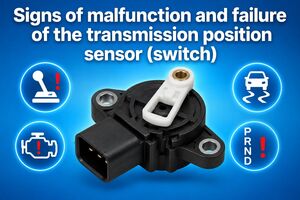
Signs of malfunction and failure of the transmission position sensor (switch)
The main
signs of the transmission position sensor malfunction are as follows: the
engine does not start, the car does not move, the transmission switches to
another gear when a certain gear is switched on, and the transmission goes into
emergency mode.
The
transmission position sensor, also called the transmission range sensor, is an
electronic sensor that provides a signal about the gear selected by the driver
to the transmission control unit (TCU). This means that the TCU controls the
transmission shift according to the command given by this sensor.
Over time,
the transmission range sensor fails or wears out. There is a number of signs indicating
this malfunction or failure.
1. The
Engine does not start, the car does not move.
Without
receiving the “Parking/neutral” signal provided by the transmission range
sensor, the TCU will not be able to signal the engine to start. That is, under
these conditions, it is impossible to start the car engine. In addition, if the
transmission range sensor fails, the TCU stops recognizing any incoming
transmission signals. Therefore, in this case, the car just will not budge.
2. When you
enable a given gear, the transmission is switched to another gear.
Sometimes,
when the selector lever is moved to a certain position, the sensor signals a
completely different gear. As a result, the TCU is controllably switched to a
gear that does not correspond to the one selected by the driver using the selector
lever. This is dangerous because it reduces the level of safety when driving
and increases the likelihood of getting into an accident.
3.
Transmission goes into emergency mode.
Some vehicles
have the following feature: if the transmission range sensor fails, it will
still be possible to turn on the transmission mechanically, but the TCU will
not receive any data about this transmission. For safety reasons, a hydraulic
or mechanical transmission lock is provided on one of the gears. This mode of
operation of the transmission is called emergency mode. Depending on the
manufacturer and the specific transmission version, the emergency mode may
involve the third gear, fourth gear, or fifth gear, as well as reverse gear.
Detection of any of these signs indicates the need to contact a mechanic.